stevin
Declarative, Terraform-style plan / apply for Databricks SQL tables — Unity Catalog and Delta.
Alpha
Every milestone in the design is built, and the assumptions stevin makes about Databricks are checked by a live test suite against a real workspace — see testing. It is still an alpha: try it on dev before production, and expect the spec format to change before the first stable release.
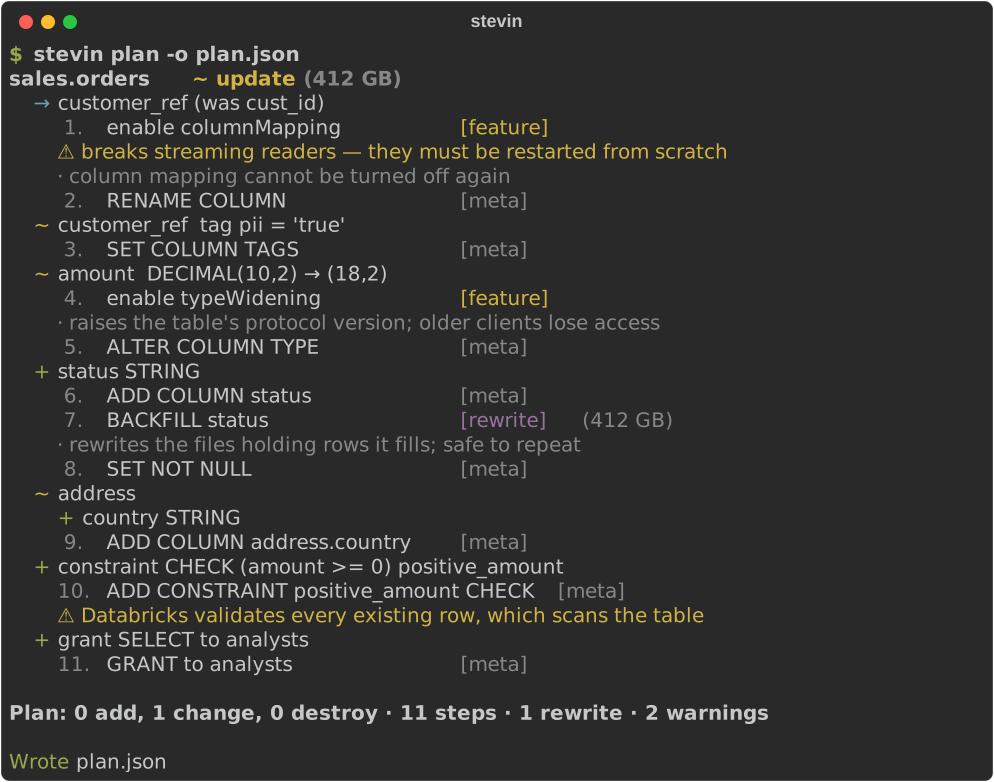
Describe the tables you want in YAML or SQL, diff that against live Unity Catalog, review a plan, then apply it. stevin knows which Delta changes are metadata-only, which need a table feature enabled first, and which force a rewrite — and it says so before it touches anything.
Get started Take the tour See every feature
Highlights
- A plan you can actually read — per table, per column, nested struct changes as a tree, numbered steps, risk labels, and size hints on anything that rewrites.
- Delta-aware planning — metadata-only vs. table-feature vs. rewrite is a classification the planner makes explicit, not a surprise at apply time.
- Safe by default — only tables stevin manages can ever be drop candidates.
Everything else is reported as unmanaged and left alone; destructive steps need
--allow-destructive. - No state file — Unity Catalog is the state. Nothing to sync, nothing to corrupt.
- Nested types are first class — struct, array and map fields diff by path
(
address.element.zip), with per-field comments and renames. - Built for CI — a
driftcommand with a non-zero exit code, a Markdown renderer for PR comments, and JSON for anything else. - Fits your stack — Python-native, Apache-2.0, and at home next to a Databricks Asset Bundle: it reads your bundle's targets, variables and schemas, and leaves what the bundle declares to the bundle.
Next steps
- Get started — your own workspace: install, import, plan, apply.
- A tour — one project from nothing to a reviewed pull request, in ten minutes.
- With an Asset Bundle — if your project already has a
databricks.yml. - Feature gallery — every kind of change, with its spec and its plan.
- Installation — install with uvx, uv tool, or pipx.
- Writing a spec — the YAML format, types, and renames.
- Commands —
validate,import,plan,apply,drift. - Safety model — ownership, risk classes, and what stevin refuses to do.
stevin is named after Simon Stevin (1548–1620), engineer and mathematician, who designed sluices and introduced decimal notation. Precision before action.
Community project, not affiliated with or endorsed by Databricks.