Tables your notebooks write
A notebook appends to a table every night. Somebody made that table once, by hand, and nobody knows what it should look like any more. stevin keeps its shape and its access in a spec, and the notebook keeps writing to it.
The notebook may change the table. This page is the loop that keeps the spec true when it does:
- A spec declares the table, and stevin creates it.
- The notebook writes to it, and sometimes adds a column.
stevin driftshows the change, every night.stevin adoptputs it into the spec, as a diff to review.
A change someone wants to make on purpose goes the other way: a spec change, and a reviewed plan.
1. Declare the table
# Sensor readings, appended by the ingest notebook
table: ${catalog}.iot.readings
comment: One row per reading
cluster_by: [taken_at]

grants:
  - principal: analysts            # who may read it
    privileges: [SELECT]

columns:
  - name: reading_id               # the key the notebook merges on
    type: bigint
    nullable: false
  - {name: taken_at, type: timestamp}
  - {name: value, type: double}

constraints:
  - primary_key: {columns: [reading_id], name: readings_pk}
stevin apply creates the table with its key, its clustering and its grant, and marks
it as stevin's. The notebook no longer needs a CREATE TABLE IF NOT EXISTS cell, and
the grant no longer needs a setup notebook.
2. The notebook writes
The notebook is unchanged. It appends, and one day the source has a field the table doesn't:
readings = spark.read.json("/Volumes/dev/iot/landing/")

(
    readings.write.mode("append")
    .option("mergeSchema", "true")
    .saveAsTable("dev.iot.readings")
)
With mergeSchema, Delta adds the column the table lacks: nullable, at the end
(schema evolution). The write
succeeds. The table now has a column the spec doesn't mention.
That is allowed. stevin does not run in the notebook and does not stand between the notebook and the table.
3. Drift shows it
drift compares the live tables with the specs. It exits with 0 when they match and
with 2 when they differ, so a nightly job fails on the
morning after the notebook's change.
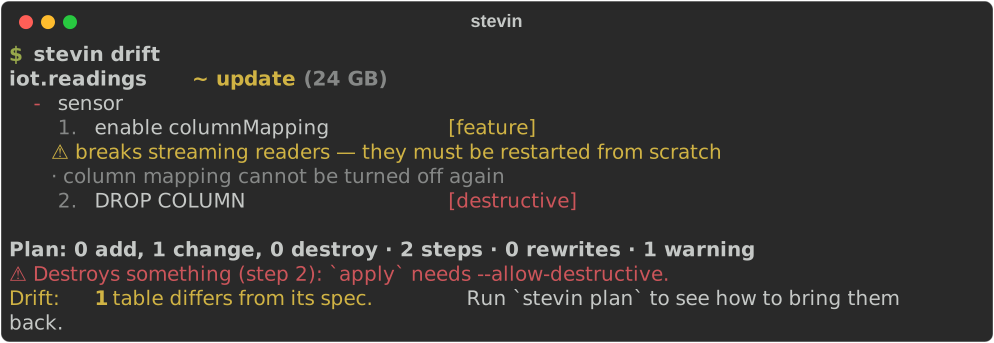
Drift is printed as a plan: what apply would do to make the table match the spec
again. Here that is dropping the new column. Nobody has to run that plan, and apply
refuses the drop without --allow-destructive. The rows the notebook wrote are not
drift: stevin compares shape and access, never data.
4. Adopt puts it into the spec
The column was usually wanted. adopt writes it into the spec file that already
describes the table. No table is touched.

# Sensor readings, appended by the ingest notebook
table: ${catalog}.iot.readings
comment: One row per reading
cluster_by: [taken_at]

grants:
  - principal: analysts            # who may read it
    privileges: [SELECT]

columns:
  - name: reading_id               # the key the notebook merges on
    type: bigint
    nullable: false
  - {name: taken_at, type: timestamp}
  - {name: value, type: double}
  - {name: sensor, type: string}

constraints:
  - primary_key: {columns: [reading_id], name: readings_pk}
The file is edited, not rewritten: the comments, the ${catalog} and the layout are
as they were. The result is a git diff. Open a pull request with it, and the review
that would have happened before the change happens after it. Once it is merged, the
plan is empty:

A column that was not wanted is a conversation with the notebook's author first. Then
the plan from step 3 removes it, with --allow-destructive.
adopt → lists what it takes from the workspace and what it leaves
alone.
A change made on purpose
A new clustering key, a tag, a grant for another team, a wider type: these start in the spec.
- Edit the spec, and open a pull request.
- The Action comments the plan: which steps are free, which rewrite the table, which destroy something.
- On merge,
stevin applyruns the reviewed plan.
A column the notebook is going to write can be added the same way, before the notebook
writes it. Then the write needs no mergeSchema, and there is no drift the next
morning.
While a notebook is being developed, it should write to a table of its own. Every
target has its own ${catalog}, and a bundle's development target gives each developer
their own schema names:
Development mode.
When the notebook owns the shape
Some teams want the notebook to decide the columns, and only want the access kept in
git. Name the table in owned_elsewhere, and write a
governance-only spec: tags, grants, masks, a row
filter and an owner, with no column types. stevin then never creates, reshapes or drops
the table, and a new column is not drift.
What stevin does not do
- It does not run in the notebook. There is no notebook entry point. stevin applies from CI, or as a job task where CI can't reach the workspace.
- It does not load data. The notebook writes the rows. stevin never reads them, moves them or checks them, except in a rewrite that a reviewed plan asked for.
- It does not stop a write. A notebook with
MODIFYon the table can change it. stevin reports the change the next timedriftruns, and not before. - It does not adopt by itself.
adoptis a command a person runs, and its result is a diff a person reads.
How this is tested
The pictures on this page are stevin's own output, made by tests/screens.py against
the fake warehouse.
tests/integration/test_live_notebook_tables.py runs the same loop against a real
workspace: create the table from the spec, write to it, add a column, read the drift,
adopt, and plan again. It then checks that the rows are still there and that the table
still carries stevin's marker. That test simulates the notebook through a SQL warehouse:
an INSERT, and an ALTER TABLE … ADD COLUMNS, which is what an append with
mergeSchema leaves behind. It does not run PySpark, and it does not cover a write
that replaces the table's schema (overwriteSchema).